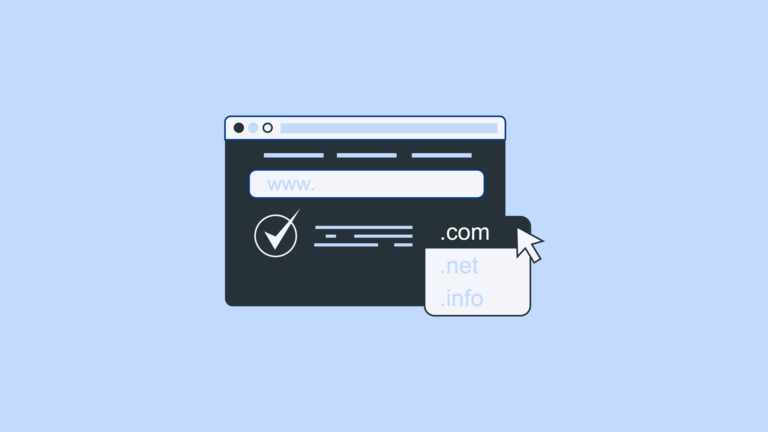
Your domain extension says a great deal about your business. With .com domains being snapped up quickly and over 1,600 alternatives now available, selecting the right one is trickier—and more crucial—than ever.
In this guide, we’ll outline the best domain extensions for various types of businesses in 2025, and provide a simple framework to help you choose the most suitable one.
Domains Are Evolving—Are You?
With hundreds of domain extensions now on offer, one thing is clear: people want options. Gone are the days when we were limited to a few classic domains such as .com, .net, .org, or .edu.
Since the early 2010s, the number of available top-level domains (TLDs) has soared—and that growth shows no signs of slowing. This expansion was fuelled by competition and demand for alternatives to the traditional .com.
This shift allowed businesses and communities to express their identities more clearly. Domain names once unavailable under .com became accessible again, creating a more open and less restrictive online environment.
From our experience supporting business owners and start-ups, we’ve seen a clear trend in 2025: branding, SEO, and memorability are now priorities, not afterthoughts.
A domain name and its extension have become essential parts of a business’s identity. Selecting the right TLD matters more now than it did a decade ago. We’ve even seen clients re-evaluate their entire branding strategy based on their domain’s impact.
To make it easier, we’ve compiled a quick-reference table of our top TLD picks for businesses in 2025. Each includes its advantages and considerations. Let’s explore.
| Domain | Best For | Why Choose It | Considerations |
|---|---|---|---|
| .COM | General businesses, brands, personal projects | Most globally trusted and easy to recall | Highly saturated; many names already registered |
| .NET | Tech firms, infrastructure, tools | Reliable alternative to .COM | Perceived as secondary; lower brand authority |
| .ORG | Non-profits, charities, community initiatives | Authoritative and trusted | May confuse users if used commercially |
| .CO | Start-ups, contemporary brands | Short, sleek, modern; good availability | Can be mistaken for .COM; often costlier |
| .AI | AI start-ups, tech products | Trendy, relevant in AI sector; memorable | Higher pricing; niche beyond tech |
| .TECH | Tech firms, developers, IT services | Clear tech focus; strong name availability | Often more expensive than .COM |
| .STORE | eCommerce and online retail | Immediately signals commercial intent | Niche appeal; not always cost-effective |
The Classic Choices
Before looking at trendier options, let’s revisit why the “classics” still matter. Three extensions—.COM, .NET, and .ORG—have long-standing reputations and still carry significant weight.
.COM
Originally created for “commercial” sites, .COM has since become the gold standard for domains. From blogs and online shops to non-profits and personal portfolios, virtually every kind of website uses it.
Advantages:
- Professionalism: A .COM domain instantly conveys legitimacy.
- Memorability: It’s the default in people’s minds, making it easy to remember.
- Affordability: Despite its popularity, .COM remains cost-effective—usually between £10–£16 per year (or less if you register with us).
Drawbacks:
- Oversaturation: Due to high demand, finding a short, brandable .COM domain can be quite challenging.
Despite the competition, .COM remains the most dependable TLD available today.
.NET
Initially intended for network services, .NET has grown into a mainstream alternative to .COM. It’s especially popular among tech-oriented businesses.
It offers many of the same advantages as .COM but may lack the same branding punch. If your ideal .COM is taken, .NET is often the next best option.
.ORG
Favoured by non-profits and cause-based organisations, .ORG has an air of trustworthiness and mission-driven authenticity. It stands out precisely because it isn’t the default.
Using .ORG tells visitors that your organisation stands for something. It suggests values, purpose, and reliability—all while remaining reasonably priced.
Emerging Domain Extensions That Work in 2025
While the classics are still relevant, the domain name landscape has expanded dramatically. Today, businesses have access to a wide range of newer TLDs that are meaningful, brandable, and far less crowded than .COM.
Let’s look at some strong options for 2025:
.CO
Originally Colombia’s country-code TLD, .CO has evolved into a modern alternative to .COM. It’s especially popular with start-ups and digital creators. It’s global, professional, and just as memorable—yet often has more name availability.
.AI
You might be surprised to learn that .AI is the country-code for Anguilla. It’s been around since the 1990s but has recently become synonymous with artificial intelligence.
Today, even non-AI-focused companies use it to project innovation. It signals cutting-edge tech, which makes it an attractive option for start-ups.
Just note: if your business serves a specific local market, a country-specific domain like .UK may be more effective for local SEO.
.TECH
Ideal for all things tech—whether it’s software, hardware, or consulting. .TECH makes it immediately obvious what your brand is about.
Want a memorable domain? Try something like cyber.tech. Clean, relevant, and impactful.
.STORE
As the name suggests, .STORE is a natural fit for eCommerce. It instantly signals that your site is about selling—whether it’s physical goods, digital products, or services.
Domains like tech.store demonstrate just how powerful a well-chosen .STORE domain can be.
Honourable Mentions: Bonus TLDs to Explore
If none of the above fit your business, don’t worry—there are plenty more worth considering:
- .IO – Popular in tech circles due to its dual relevance (British Indian Ocean Territory and “input/output” in computing).
- .APP – Ideal for app developers or software companies.
- .DESIGN – A perfect fit for designers of all kinds.
- .LAW – Professional and tailored for legal practices.
- .MEDIA – A strong choice for content creators, producers, and publishers.
- .HEALTH / .CLINIC – Great for healthcare services and private practices.
- .ACADEMY – Excellent for online learning platforms and tutors.
Still can’t find the right fit? With over 1,500 TLDs out there, you’re bound to discover one that suits your brand perfectly.
Domain Extensions to Be Cautious Of
To save you time (and money), here are a few types of TLDs we typically advise against:
- Overpriced: Extensions like .GLOBAL, .FINANCE, .MARKETING, and .EXPERT may sound enticing but are often costly without offering significant branding benefits.
- Low Memorability: TLDs like .INTERNATIONAL, .ACCOUNTING, or .SOLUTIONS are long and hard to recall. Avoid them unless absolutely necessary.
- Low Trust: Domains such as .XYZ, .TOP, .CLICK, and .REVIEW are frequently used for spam or low-quality sites. While not inherently bad, they may trigger suspicion from users or spam filters.
How to Choose the Right Domain Extension
Feeling overwhelmed by choice? These three criteria will help narrow down your options:
- Industry Relevance: Select a TLD that aligns with your sector—it adds professionalism and clarity.
- Trust & Recognition: Choose extensions that people trust and associate with quality.
- Availability: Newer TLDs usually offer more naming freedom, so consider them if your ideal .COM is unavailable.
But What About SEO?
Here’s the good news: your choice of TLD does not directly impact Google rankings. All TLDs are treated equally—except for country-specific ones, which can help with local SEO.
What matters most for SEO is quality content, solid backlinks, and a good user experience.
A Domain Extension Speaks Volumes
Your domain name is more than a web address—it’s your brand’s first impression. It helps build trust, convey your purpose, and shape how people perceive your business.
Pick one that reflects your goals, resonates with your audience, and supports your identity.
FAQs
Are newer domain extensions like .AI or .TECH as credible as .COM?
Absolutely. Especially in tech sectors, these TLDs are now widely accepted. Trust depends more on how a domain is used than the extension itself.
Will a domain extension affect SEO?
Not directly. Google treats most TLDs equally, aside from country-specific domains, which aid local SEO. Prioritise content and user experience instead.
What’s the downside to using a .COM in 2025?
Availability. The best names are often already taken, which may force you to compromise or get creative.
Should I opt for a trendy extension like .STORE or stick to a classic?
It depends on your goals. Trendy TLDs can enhance brand identity and memorability. Classics lend credibility. Match the TLD to your brand’s personality.
How do I check if a TLD has a poor reputation?
Some, like .XYZ or .CLICK, are commonly associated with spam. That doesn’t make them bad, but be mindful of potential red flags with users or spam filters.
What if my desired .COM domain is taken?
Try alternatives like .CO, .NET, or a relevant TLD like .MEDIA or .DESIGN. You might preserve your branding while gaining availability.
Should I buy multiple domain extensions to protect my brand?
If budget allows, yes. Owning multiple TLDs (.COM, .NET, .CO) can protect your brand from impersonators and improve visibility.